Italian
  English
  German
  Spanish
  Russian
  Arabic
  Korean
  Japanese
  French
  Dutch
Dutch  Danish
  Norwegian
  Portuguese
  Turkish
  Czech
Czech  Lithuanian
  Polish
  Slovenian


Can a Gold Flip Top Cap Pass Food or Cosmetic Contact Safety Testing?
Indice dei contenuti
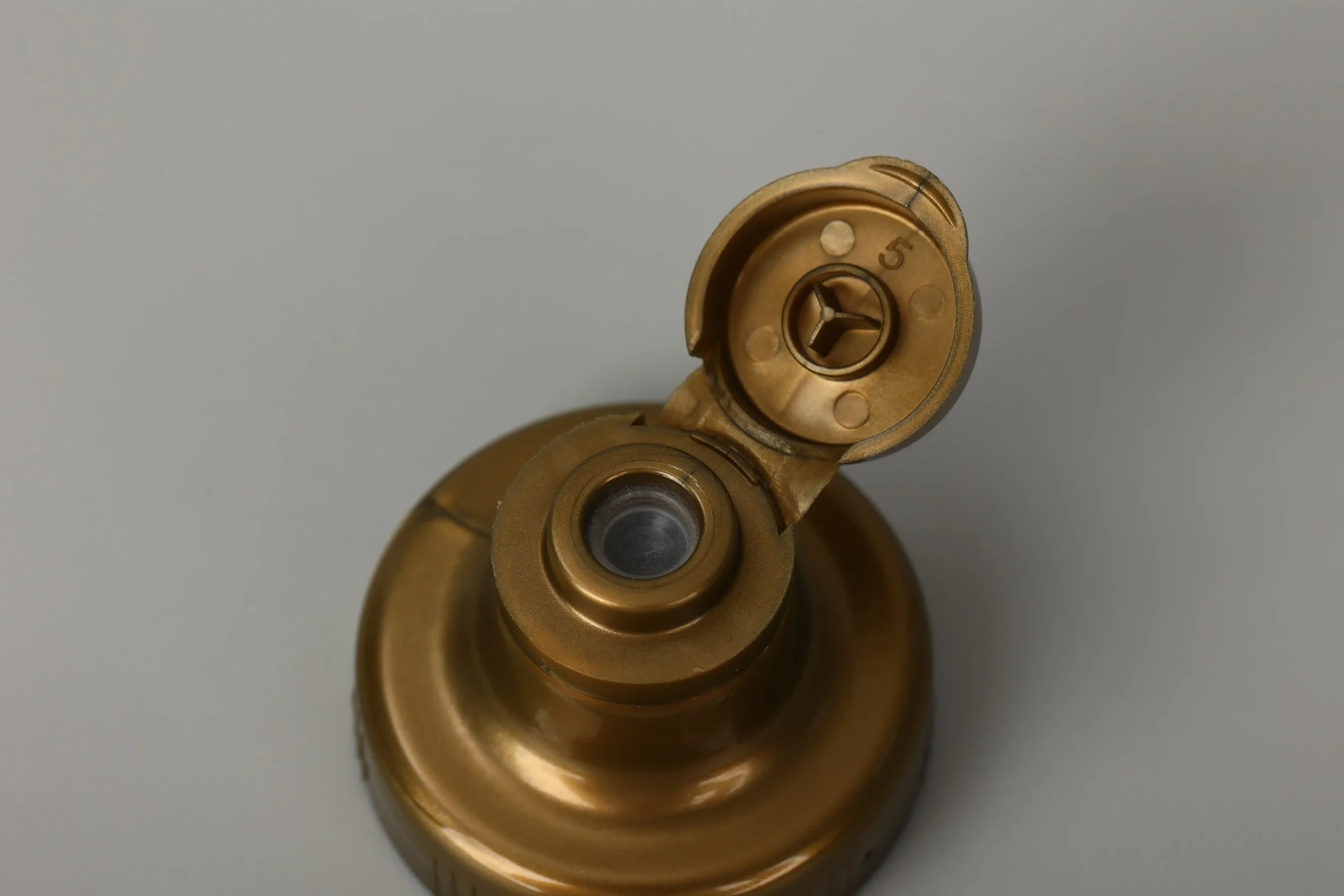
A gold flip top cap looks like a small detail on a bottle, but the finish itself carries more complexity than most buyers expect. Underneath that gold shine sits a layered structure — often metal, not just tinted plastic — and that structure raises real questions for anyone sourcing packaging for food or cosmetic products. Before approving a gold-plated cap for production, buyers need to understand what’s actually in that coating and what testing confirms it’s safe for its intended use.
Why Does Electroplating Raise Safety Questions for Flip Top Caps?
A plated gold cap isn’t just plastic with gold-colored resin mixed in. Most electroplating processes build up several thin layers on top of the plastic base — typically a metal layer like copper or nickel first, then the gold finish, then a clear UV protective topcoat to keep the shine from dulling.
That layered structure is exactly why plated caps get more scrutiny than caps colored with a standard pigment or masterbatch. A solid-color plastic cap has one material to test. A plated cap has several, stacked on top of each other, and each layer can behave differently under contact, friction, or exposure to a product’s chemistry. This doesn’t mean every plated cap is unsafe — it means the safety case has to be built differently than it would for a plain plastic closure.
What Metals Are Used Under the Gold Layer, and Why Does It Matter?
Nickel shows up often in gold electroplating, either as a base layer or part of an alloy that helps the gold adhere evenly to the plastic. Chrome sometimes plays a role too, depending on the plating process a supplier uses.
Under normal conditions, this metal layer sits beneath the gold finish and doesn’t touch the product directly. But packaging doesn’t always behave the way a drawing suggests. Cap wear at the opening edge, a poorly sealed dispensing tip, or repeated skin contact on a lip or cream product can create situations where that underlying metal becomes relevant to safety review. This is exactly why regulators single out nickel for testing in categories like cosmetics, where skin contact is frequent and direct.
Articoli correlati:Il libro di testo
Which Safety Tests Should Buyers Request for a Gold-Plated Cap?
“Food grade” or “cosmetic safe” as a general phrase doesn’t tell a buyer much on its own. For a plated cap, the more useful documents include:
- Migration testing results, showing whether substances transfer from the cap into the product or a simulant
- Nickel release testing, often referenced against EN 1811, a standard used to measure nickel release from items with prolonged skin contact
- Material information for both the plastic substrate and the metal layers used in plating
- Food contact compliance documentation under frameworks like EU Regulation 10/2011 or FDA food contact requirements, when the application involves food
A supplier should be able to hand over test reports tied to the specific plating process and cap design in question, not a general certificate that covers an entire product category. If a supplier can’t produce documentation for the exact article being ordered, that’s worth asking about before samples move forward.
Does Electroplated Gold Behave Differently for Food vs Cosmetic Applications?
Food and cosmetic contact aren’t judged by the same rulebook, even when the cap looks identical on the outside. A gold cap on a seasoning bottle falls under food contact regulations, which focus on what might migrate into something a person eats or drinks. A gold cap on a lip balm or cream jar falls under cosmetic regulation, where skin contact and absorption through skin become the central concern — this is where nickel release limits usually apply most directly.
Buyers sometimes assume a compliance document written for one application automatically covers the other. It doesn’t. A cap approved for food contact hasn’t necessarily been tested against cosmetic-specific nickel limits, and the reverse is true as well. The safest approach is to confirm which application the documentation actually addresses before assuming coverage extends further.
What Should You Confirm Before Approving a Gold Flip Top Cap for Production?
Before a gold-plated cap moves from sample to mass production, a few pieces of information should be on file. Buyers should ask the supplier to explain their specific plating process and confirm which metals sit beneath the gold layer. Third-party test reports covering migration and, where relevant, nickel release should match the exact cap and coating being ordered — not a similar product from the same supplier.
It also helps to review coating thickness and whether a protective topcoat is applied, since wear at contact points affects both appearance and long-term safety performance. Testing with the actual product during the sample stage, rather than relying on visual approval alone, catches problems early — before a full production run makes changes expensive.
Pensieri finali
A gold flip top cap can work well for food or cosmetic packaging, but the finish adds a layer of complexity that plain plastic doesn’t carry. Confirming what’s under the gold, requesting the right test reports for the actual application, and checking coating durability before mass production are the steps that separate a safe, well-documented cap from one that raises questions later.
Gold Flip Top Cap Compliance
Find answers about nickel layers, electroplated gold finishes, coating durability, nickel release testing, and food or cosmetic compliance.
Does a gold flip top cap always contain nickel underneath the gold layer?
Not always, but many gold electroplating processes use a nickel or nickel-alloy base layer before the gold finish is applied. Buyers should ask the supplier directly which metals are used in their specific plating process, since formulas vary between manufacturers.
Is an electroplated gold cap automatically food-grade or cosmetic-grade safe?
No. Electroplating adds a metal layer on top of the plastic, and that layer needs its own testing and documentation. A cap made from food-grade plastic resin doesn't automatically mean the plated finish meets the same safety standard.
What is nickel release testing, and why does it matter for a gold cap?
Nickel release testing measures how much nickel might transfer from a metal or plated surface through contact, sweat, or product exposure. It matters most when the cap has direct or repeated contact with skin or product, and it's a common requirement under EU cosmetic and consumer product regulations.
Can the gold coating wear off and expose the metal layer underneath?
Over time and with enough friction, a plated coating can wear thin, especially at contact points like the cap's opening edge. This is one reason buyers should ask about coating thickness and any protective topcoat, in addition to safety testing results.
Do food contact and cosmetic contact caps need different compliance documents?
Generally yes. Food contact applications usually reference regulations like EU 10/2011 or FDA food contact requirements, while cosmetic applications follow separate frameworks such as EU cosmetic regulation limits on nickel release. A document that covers one application doesn't automatically cover the other.
Tutti i tappi in stock e consegna rapida
Richiedi subito un campione gratuito
Pronto per la spedizione entro 3 giorni. Prezzo competitivo. Campioni gratuiti disponibili!
*Quantità minima ordinabile di 10.000 unità.